
This is an old revision of the document!
Table of Contents
Head with gas mask
Materials used for printing
- For every part except the ears: LWPLA (ColorFabb) from 3Djake
- For the ears: Foamy TPU (FilaFlex) from 3Djake
Materials used for post processing/painting
- For all things black: Vallejo Model Air Black RLM22 (V71057)
- Primer: Vallejo Surface Primer USN Light Ghost (70615)
- Varnish: Vallejo Model Color Gloss Varnish (V70510) I did have a bit of a “problem” with this varnish though, it stayed somewhat “tacky” even weeks after being applied. It has been suggested to me to wipe it with IPA but I haven't tried that yet, so be aware that this might not be the ideal varnish.
The head consists of the following printed parts:
- Front shell (gas mask)
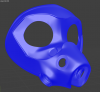
- Back shell
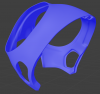
- Backplate
- Adapters for the “filters (x2)
- Filter “stem” (x2)
- Filter body (x2)
- Filter cap (x2)
- Filter hose connection (x2)
- Filter to hose adapter (x2)
- Gas mask tip
- Gas mask top cap (x2)
- Eyeplate
- Eye (x2)
- Ear (x2)


Additional, non printed, non electronic parts:
- Hinge hardware (two slotted bolts, and two slotted barrel nuts)
- Visor: Cut out of tinted PVC sheet
- Magnets to keep the head closed
- Magnets to keep the visor secure
- Padding made out of memory foam
- Thin black EVA foam for the bottom of the padding to hide the bright yellow padding foam
- Velcro strips to hold the padding in, so the padding can be swapped out/cleaned
- The same kind of mesh typically used for fursuit eyes, used for the ear holes (the ones on the side for my actual ears and the ones in the suit ears), painted black (you can use a sharpy for this or airbrushit, whatever works)
Headshell
To reduce weight the headshell and all other components (except for the ears) were printed using LW-PLA (lightweight PLA). This pla foams up above a certain temperature, which reduces its density greatly. There is a tradeoff of course, because as the density reduces so does the strength. Although in my experience even at 50-60 % weight (compared to “solid” PLA) it's still pretty tough and flexible.
My typical post processing sequence for PLA prints is as follows. Keep in mind this is just what I do CURRENTLY, and this is an ever evolving process and I do not claim this to be the “best” or “correct” way to do it!
- Remove brims, burrs, and strings
- Coarse initial sanding using 240 grit paper (dry)
- Glue what you need to glue together, if there are multiple parts to combine
- Second coarse sanding using 240 grit paper (dry)
- Spray with filler and let it dry (spraycan)
- Sand with 400 grit paper (wet)
- Spray with filler and let it dry
- Sand with 600 grit paper (wet)
- Spray with filler and let it dry
- Sand with 800 grit paper (wet)
- Optional: Spray with filler and let it dry
- Optional: sand with 1200 grit paper (wet)
- Spray primer pass 1(airbrush) and let it dry
- Spray primer pass 2 (airbrush) and let it dry
- Spray colour pass 1 and let it dry
- Spray colour pass 2 and let it dry
- Optional: Spray colour pass 3 and let it dry
- Spray varnish pass 1 and let it dry
- Spray varnish pass 2 and let it dry
- Optional: Spray varnish pass 3 and let it dry
You may need to repeat one or more of these steps (especially during sanding) depending on the print, and how fine of a finish you'd like.
Print settings for LW-PLA I used (on modified CR-10S with a microswiss direct drive extruder):
- Extrusion multiplier: 0.52
- Print temperature: 225 C
- Print speed: 50 mmm/s
- Retract distance: 0.5 mm
- Retract as few times and as little as possible, otherwise the hotend may clog!
- Wall loops: 3
- Infill: 10 % rectilinear
- 4 top and 4 bottom shells
- Layer height: 0.2 mm
Ears
Initially the ears were printed out of regular TPU with a very sparce infill. This resulted in very heavy (250 grams each) ears, which made wearing the head pretty much impossible (very uncomfortable, too much inertia, and stress on neck).
For the final version, they have been printed using LW-TPU, without any infill, with 2-3 outlines (need to check). They then recieved a grey primer (Vallejo, 2 layers) and then were painted black(using Vallejo air black, again 2-3 layers). Finally they recieved 2-3 layers of glossy varnish. I used an airbrush for all of the paint layers. This resulted in ears that are under 100 grams each, which made a huge difference in comfort.